
- Call Us: +20 155 691 9966
- Email:info@alfolk.net

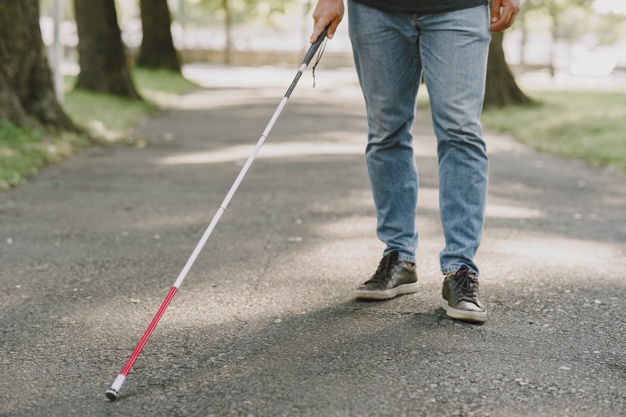
• In previous articles, we learned about the concept of disability and the first type of disabilities (mental disability) and how countries’ degree of advancement is determined by the amount of their investment in human energies of all categories, including those with special needs. And in today’s article, let’s learn about the second type of disability.
Secondly, Sensory Impairments
Which results from injury in one or more of the sense organs and the nerves to them (eyes, ears, tongue).
A- Visual impairment:
It is a visual impairment (complete or partial visual impairment) even after visual correction surgically or with lenses, to the extent that hinders the individual from learning through ordinary educational methods that depend on sight, so we resort to special education programs with this category of people.
The main classifications of this category are:
Blind: Completely blind: A person who is unable to recognize the strong light that shines directly into their eyes.
Legally blind: A person whose visual acuity, with the strongest eye of the two after correction, is less than 6/60 meters (20/200 feet)…or whose visual field is less than an angle of 20 degrees.
Note: 20/200 means that an object that the natural eye sees at a distance of 200 feet will only be able to see it at a distance of 20 feet
Low vision: a person whose visual acuity ranges between 6/24 and 6/60 meters (20/20,80/200 feet) with the strongest eyes after making possible corrections.
Classifications of visual impairment vary according to the criteria used:
1 – Degree of visual impairment criterion: total visual impairment – partial visual impairment. The blind are classified into four categories:
-Total blindness: a category of people who were born blind or lost sight before the age of five.
-Total blindness: a category of people who lost sight after the age of five.
-Partial blindness: a category of people who were born or lost sight before the age of five.
-Partial blindness: a category of people who were born or lost sight after the age of five.
Time is the basis of this classification, because a child, who loses his sight before the age of 5, cannot keep visual images in his mind.
2- Cause of visual impairment criterion, including the causes before, during and after birth (environmental and personal factors).
3- Sight criterion, according to the Snellen scale, which includes:
-Completely blind, whose visual acuity is less than 20/200.
-Blind people who can perceive movement and have a visual acuity of 5/200.
-Blind people who can read and have a visual acuity of 10/200.
-Blind people who can read and have a visual acuity of 10/200, but their visual acuity does not qualify them for daily life.
Type of visual impairment criterion: (farsightedness – myopia – astigmatism – corneal infections – strabismus – eye movement – color blindness – photophobia.
Causes of visual impairment:
A – Prenatal causes: They are related to genetic and environmental factors (genes, infectious diseases, rubella, medications, X-rays), examples of which are cases of nearsightedness and farsightedness and the birth of a child completely or partially blind.
B – Postpartum causes: They are related to environmental and personal factors such as (advancing age, malnutrition, accidents, diseases, eye injuries), which, if neglected, may lead to blindness or poor visual acuity in humans (cataract, glaucoma or inflammation, trachoma, iritis, or keratitis).
What we should consider in the world of the visually impaired:
–Decreased life experiences compared to normal people, due to the inability to move easily and skill of their sighted peers. Some individuals who compensate for this by getting help from others in their life matters, and using the rest of their senses are excluded here.
-Some of the visually impaired have the desire to depend and seek help and assistance from others in many matters of their life, and have excessive feeling of that which results in rejecting the self, and even hating it, and therefore social incompatibility.
-Distraction of feelings because they live in two worlds (the world of their own) and in which they live using the rest of their senses according perception; and the general world (normal to the sighted person) where they try as much as possible to imagine life in it.
-Aggression sometimes (by word or deed) because of their sense of inferiority due to loss of sight and consequently lack of experience and inaccurate perception of the reality of life.
-Anxiety and turmoil as a result of the insecurity that arouse in them as a result of the loss of sense of sight.
-Feeling of frustration due to the repeated failure in their attempts to live like other people, and thus lack of self-confidence and low level of self-esteem, this leads to isolation, introversion and a feeling of alienation.
– Emotional imbalance, disproportionate emotion towards different life situations, and permanent and continuous use of defensive methods such as denial, compensation, projection and justification, as means to help them, even if temporarily, to psychological comfort.
-The blind person does not need a loud voice when you speak to him and do not ask him to turn to you while you are talking to him.
-Do not ignore his presence when you enter or leave the place where he is in.
In general, the visually impaired is considered less self-adapted, less receptive to other people and has less sense of belonging to the sighted community. This reveals the extent of the responsibility of the sighted community in lending a helping hand with full awareness to meet the needs of this category. The category which brought us many inspiring examples that left behind successes that many sighted people did not achieve. Helen Keeler is unforgettable example (the blind and deaf American writer), Taha Hussein, the Minister of Education and the famous writer – Sayed Makkawi and Ammar Al-Sharei, the geniuses of Egyptian music, and the blind American Erik Weihenmayer who succeeded in climbing Mount Everest, the highest mountain in the world, in 2001 … and many others.
All rights reserved to Al-Folk Charitable Foundation © 2021
Leave Your Comments